
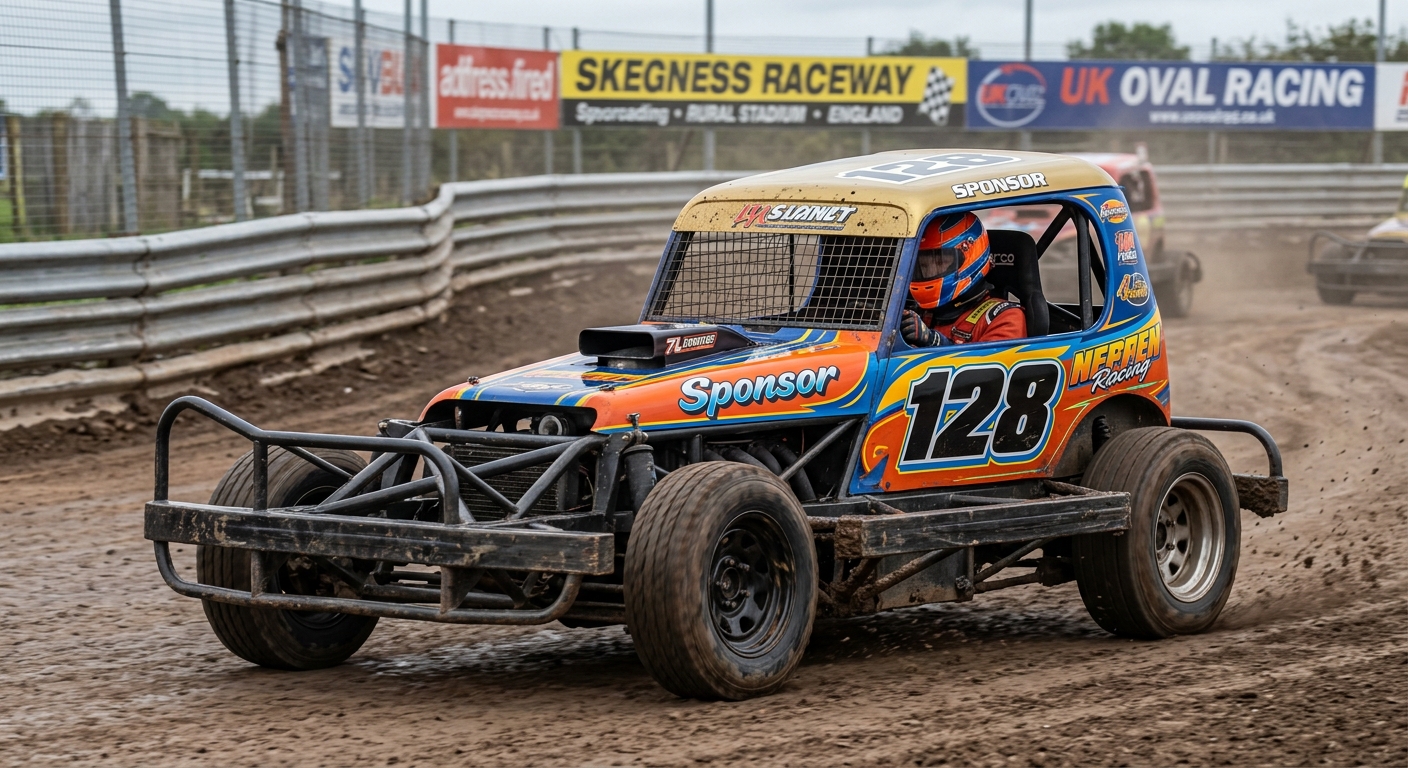
From Post-War Scrap Heap to High-Octane Sport: The History of UK Stock Car Racing
Unlike its American counterpart born out of Southern bootlegging, British stock car racing was forged in the post-war industrial landscape of the mid-1950s. Built on contact-heavy racing, custom-engineered mechanics, and grassroots crowds, the UK circuit grew into a uniquely British motorsport phenomenon.
The Birth: London 1954
The story of UK stock car racing began on April 16, 1954, at the Harringay Arena in London.
- The Founder: Canadian promoter Dalle “DDR” Taylor introduced the concept to Britain after observing the wild success of contact auto racing in North America and Australasia.
- The First Meeting: Over 30,000 spectators turned out to watch 30 drivers compete in heavily modified pre-war saloon cars. The event was an instant sensation.
- The Original Cars: Early machines were simple, heavy road vehicles—Ford V8s, Austin 16s, and Humber Hawks—fitted with iron bars, stripped interiors, and reinforced bumpers to withstand heavy collisions.
The sport expanded rapidly across greyhound and speedway stadiums throughout Great Britain, with tracks opening in Belle Vue (Manchester), Coventry, Brandon, and Wimbledon.
The Split: Formula 1 and Formula 2 (Late 1950s–1960s)
As the sport matured, the cost of running large V8 engines caused a division in the ranks, leading to the creation of two distinct classes:
- Formula 1 (F1) Stock Cars: The big-engine, unlimited division. Initially based on heavy American chassis and V8 engines, these evolved into purpose-built, open-wheel, spaceframe race cars equipped with massive steel bumpers (rubbing bars) designed for heavy contact.
- Formula 2 (F2) Stock Cars: Established in 1960 (originally known as Senior Stock Cars or “BriSCA F2”), this division offered a lower-cost, highly accessible entry point. Using smaller engines (traditionally Ford 2-litre Pinto engines), F2 became immensely popular across smaller regional ovals.
Governing bodies like BriSCA (British Stock Car Drivers Association) were formed to regulate rules, ensure track safety, and manage driver grading systems.
The Unique UK Racing Format
British stock car racing developed a handicap system designed purely for spectator entertainment, setting it apart from almost all other international motorsports:
| Driver Grade | Roof Color | Starting Position |
| Novice / Lower Grades | White / Yellow | Front of the grid |
| Intermediate Grades | Blue | Middle of the grid |
| Star / National Points | Red | Back of the grid |
| World Champion | Gold | Rearmost position on the grid |
Because the fastest drivers start at the very back, they must physically push, nudge, and bumper their way through the slower traffic ahead to win, guaranteeing non-stop overtaking manoeuvres and heavy contact.
Expansion and Modern Evolution
Through the 1970s and beyond, short-oval racing in the UK expanded to include several specialised categories alongside traditional BriSCA F1 and F2:
- Banger Racing: Embraced full-contact, demolition-style racing using end-of-life road cars, becoming a staple of bank holiday entertainment across Britain.
- Saloon Stock Cars: Heavy-contact racing utilising modern hatchbacks and saloon bodies fitted with structural steel armour.
- National Hot Rods: Non-contact oval racing focused on extreme speed, precision setup, and high-performance cornering.
Today, UK stock car racing remains a thriving, family-run, grassroots sport. Tracks like Skegness, Ipswich, Hednesford Hills, and Cowdenbeath continue to draw dedicated crowds every season to watch custom-built 600-horsepower V8 monsters battle on short tarmac and shale ovals.